The Tsavo Lions are among the most famous lions in history. Known worldwide for the dramatic events of 1898, when two male lions repeatedly attacked railway workers during the construction of the Uganda Railway, they have become a symbol of both Africa’s untamed wilderness and one of the greatest wildlife mysteries ever recorded.
More than a century later, the story of the Tsavo lions continues to fascinate historians, wildlife researchers, filmmakers, and safari travellers. Were they truly responsible for the deaths of more than 100 people? Why did they hunt humans? Why did they have almost no manes? And do lions like them still roam Tsavo National Park today?
The answers lie in a remarkable combination of history, ecology, and science.
Today, Tsavo National Park remains one of Africa’s greatest safari destinations and is home to thousands of wild animals, including one of Kenya’s largest lion populations. Visitors have the opportunity to explore the same landscapes where the infamous Tsavo Man-Eaters once hunted while enjoying unforgettable game drives through one of the continent’s largest protected wilderness areas.
Quick Facts About the Tsavo Lions
-
Location: Tsavo National Park, southeastern Kenya
-
Famous For: The legendary “Man-Eaters of Tsavo”
-
Historic Event: Uganda Railway construction (1898)
-
Number of Famous Lions: Two adult male lions
-
Known Victims: Officially 28 railway workers; estimates range considerably higher
-
Unique Feature: Naturally short or almost absent manes
-
Current Status: Tsavo still supports a healthy wild lion population
-
Best Place to See Them: Tsavo East National Park and Tsavo West National Park
-
Best Time to Visit: June to October and January to March
What Are the Tsavo Lions?
The Tsavo lions are the wild lions that inhabit Kenya’s vast Tsavo ecosystem, one of the largest protected wildlife landscapes in Africa. Covering more than 22,000 square kilometres, Tsavo is divided into Tsavo East National Park and Tsavo West National Park, together forming a wilderness larger than many countries.
Although thousands of lions have lived here over the centuries, the name “Tsavo Lions” almost always refers to the two notorious male lions that terrorised railway construction camps in 1898.
These lions became famous after repeatedly entering workers’ camps at night, dragging victims from their tents, and disappearing into the surrounding thorn bush before dawn. Their attacks halted construction of the railway for months and created widespread fear among hundreds of labourers working along the line.
The events were later documented by Lieutenant Colonel John Henry Patterson, the British army officer responsible for supervising construction at Tsavo. His account became one of Africa’s best-known wildlife stories and inspired books, documentaries, and the Hollywood film The Ghost and the Darkness.
Today, the original Tsavo lions are preserved at Chicago’s Field Museum, where scientists continue to study their skulls, teeth, bones, and DNA to better understand what made them so unusual.
Where Is Tsavo?
Tsavo lies in southeastern Kenya between Nairobi and Mombasa. The protected area stretches across Taita-Taveta County and parts of Kitui County, making it Kenya’s largest national park.
Its location places it within one of Africa’s oldest wildlife migration corridors, linking the coastal forests with the plains surrounding Mount Kilimanjaro. This enormous ecosystem supports elephants, buffaloes, giraffes, zebras, leopards, cheetahs, hyenas, crocodiles, hippos, and more than 500 species of birds.
For lions, Tsavo offers an ideal habitat. Dense acacia bush provides cover for stalking prey, while open plains allow lions to hunt antelope, buffalo, zebra, and occasionally young elephants.
Unlike many smaller parks, lions in Tsavo roam vast territories. Individual prides may patrol hundreds of square kilometres, making each sighting feel genuinely wild rather than predictable.
Why Are the Tsavo Lions So Famous?
Many places in Africa have lions, but no lion population has achieved the worldwide recognition of the Tsavo lions.
Their fame comes from an extraordinary chapter in history that unfolded during the construction of the Uganda Railway in 1898.
At the time, Britain was building a railway linking the Kenyan coast with the interior of East Africa. Thousands of workers—many of them skilled labourers from India—were employed to construct bridges, lay tracks, and establish camps across the harsh wilderness.
One of the greatest engineering challenges was crossing the Tsavo River.
As construction progressed, two unusually bold male lions began entering the camps after dark. Despite protective thorn fences, campfires, and armed guards, the lions repeatedly broke through the barriers to attack sleeping workers.
The fear they created became legendary.
Many labourers abandoned the project, convinced the lions were supernatural spirits rather than ordinary predators. Construction slowed dramatically as workers refused to continue without better protection.
John Henry Patterson eventually took responsibility for hunting the lions himself. After weeks of failed attempts, dangerous night watches, and several close encounters, he succeeded in shooting the first lion in December 1898 and the second a few weeks later.
With their deaths, railway construction resumed.
Although the attacks ended more than 125 years ago, the mystery surrounding the lions has never disappeared. Modern scientific studies have continued to investigate why these particular lions targeted humans, revealing new evidence that Patterson himself could never have imagined.
The Tsavo Ecosystem: A Land Built for Lions
Understanding the Tsavo lions begins with understanding Tsavo itself.
Few national parks in Africa are as vast or as diverse.
The landscape ranges from open savannah and volcanic lava fields to dense thorn scrub, riverine forests, rocky hills, seasonal wetlands, and permanent springs. Rainfall varies significantly across the ecosystem, creating a patchwork of habitats that support an incredible diversity of wildlife.
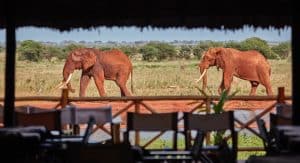
One of Tsavo’s defining features is its famous red soil. Rich in iron oxide, this fine dust coats everything it touches—including the park’s elephants, which often appear bright red after dust bathing. Lions resting beneath acacia trees frequently carry the same reddish colouring, blending almost perfectly into the landscape.
Prey is abundant throughout the park. Herds of buffalo, zebra, giraffe, impala, waterbuck, eland, and wildebeest provide food for large predators, while hyenas, leopards, cheetahs, jackals, and wild dogs compete within the same ecosystem.
The park’s size means lions behave differently from those in smaller reserves like the Masai Mara. They travel farther, encounter fewer vehicles, and often remain hidden for long periods. This makes every lion sighting feel more authentic and rewarding for safari visitors.
It is this rugged, untamed wilderness that shaped the behaviour of the famous Tsavo lions and continues to support one of Kenya’s most important lion populations today.
In the next section, we’ll explore the extraordinary story of the Tsavo Man-Eaters in detail, separating historical fact from myth while examining what really happened during one of Africa’s most famous wildlife encounters.
The Story of the Tsavo Man-Eaters
No story about the Tsavo lions is complete without revisiting the events that made them world famous. More than 125 years later, the tale of the Tsavo Man-Eaters remains one of the most extraordinary encounters between humans and wildlife ever recorded.
What began as a major engineering project in colonial East Africa soon turned into a terrifying struggle for survival, as two lions repeatedly attacked workers building one of Africa’s most important railways.
Building the Uganda Railway
In the late 1890s, the British government began constructing the Uganda Railway, a line designed to connect the Indian Ocean port of Mombasa with the interior of East Africa. The railway would eventually reach Lake Victoria, opening the region to trade, transport, and administration.
The project was enormous.
Thousands of labourers, many recruited from India because of their railway construction experience, travelled to Kenya to build bridges, lay tracks, and establish camps across challenging terrain.
One of the biggest obstacles along the route was the Tsavo River.
The area surrounding the river was remote and largely untouched wilderness. Thick thorn scrub, scattered acacia woodland, seasonal rivers, and abundant wildlife made it ideal habitat for lions, elephants, buffalo, and countless other animals.
Construction camps were temporary settlements made up of canvas tents surrounded by bomas—protective fences built from thorny acacia branches. At night, large campfires burned continuously, while armed guards kept watch in the hope of discouraging predators.
Normally, these precautions were enough.
But the lions of Tsavo were unlike any others the workers had encountered.
The First Attacks
During the early months of 1898, workers began disappearing from the camps.
At first, many assumed the missing men had deserted the difficult working conditions. The heat was relentless, disease was common, and the work was physically exhausting.
Soon, however, the truth became impossible to ignore.
Bodies were discovered partially eaten in the surrounding bush, while eyewitnesses described lions dragging sleeping men from their tents during the night.
The attacks became increasingly frequent.
The lions showed little fear of people.
They leapt over thorn fences, pushed through weak sections of the bomas, and even entered tents occupied by multiple workers before selecting a victim.
Many attacks happened only a few metres from campfires where dozens of men were gathered.
Their confidence astonished experienced hunters.
Fear Spreads Through the Camps
As the attacks continued, fear swept through the railway camps.
Workers stopped sleeping properly.
Some climbed into trees each night.
Others built raised wooden platforms or crowded together in groups hoping safety lay in numbers.
Construction slowed dramatically as frightened labourers refused to continue working.
Rumours spread quickly.
Some believed the lions were ordinary predators that had simply developed a taste for human flesh.
Others believed they were possessed by evil spirits.
Among many workers, stories circulated that the lions were supernatural beings sent to punish those building the railway.
These beliefs only intensified the panic.
Eventually, hundreds of labourers abandoned the project entirely.
The railway was at risk of coming to a complete standstill.
Enter Lieutenant Colonel John Henry Patterson
Responsibility for restoring order fell to Lieutenant Colonel John Henry Patterson, the British engineer overseeing construction of the Tsavo River bridge.
Patterson quickly realised that ordinary protective measures were failing.
He organised night patrols.
He strengthened the thorn fences.
He positioned armed guards around the camps.
He even built elevated platforms overlooking areas where the lions were expected to return.
Despite these efforts, the attacks continued.
The lions seemed unusually intelligent.
They often approached silently from unexpected directions, avoided obvious traps, and disappeared before hunters could react.
Night after night Patterson waited in darkness, hoping for a clear shot.
Weeks passed without success.
Hunting the First Lion
In December 1898, Patterson finally had an opportunity.
After using a dead animal as bait and waiting through the night, one of the lions appeared.
Patterson fired, hitting the animal.
Rather than collapsing, the wounded lion disappeared into dense bush.
The hunt continued for hours.
Tracking an injured lion through thick vegetation was one of the most dangerous situations any hunter could face. At close range, a charging lion can cover the distance to a person in seconds.
Eventually, Patterson found the wounded animal.
After several more shots, the first Tsavo lion was finally killed.
Its enormous size amazed everyone present.
Workers celebrated, believing the nightmare had ended.
They were wrong.
The Second Lion
Within days, another worker disappeared.
The second lion was still alive.
This lion proved even more cautious than the first.
It avoided traps.
It approached camps from different directions.
It seemed to recognise danger before humans detected its presence.
Again Patterson spent countless nights waiting in makeshift platforms.
Finally, several weeks after the first lion had been killed, the second appeared.
Patterson opened fire.
The wounded lion escaped into the darkness.
Over the following days it was tracked repeatedly before Patterson finally delivered the shots that killed it.
Only after both lions were dead did the attacks stop completely.
Construction of the railway resumed, and workers slowly regained their confidence.
How Many People Did the Tsavo Lions Kill?
This question has been debated for more than a century.
John Henry Patterson claimed in his 1907 book, The Man-Eaters of Tsavo, that the lions killed 135 people during the nine months they terrorised the railway camps.
The figure became famous around the world and is still widely quoted today.
However, modern scientific research paints a more complicated picture.
By studying the chemical composition of the lions’ preserved hair and bones, researchers were able to estimate how much human flesh they actually consumed before being killed.
Their findings suggested the two lions probably fed on the equivalent of around 35 people, although this does not necessarily represent the exact number of victims. Some victims may have escaped, while others may have been only partially consumed. Likewise, not every person reported missing was necessarily killed by the lions.
Most historians therefore agree on three important points:
-
The attacks unquestionably occurred.
-
The lions killed a significant number of people.
-
The exact death toll will probably never be known with certainty.
Today, many experts estimate that between 28 and 35 people were likely killed, while recognising that Patterson’s famous figure of 135 helped shape the legend that followed.
Why Did the Tsavo Lions Attack Humans?
For decades, this question puzzled scientists.
Healthy lions generally prefer natural prey such as zebra, buffalo, wildebeest, and antelope. Hunting humans is unusual because people are comparatively small, often travel in groups, and can be dangerous.
Several factors may explain the Tsavo attacks.
1. Disease and Injury
One of the lions had severe dental damage.
Scientists found that one canine tooth was broken and infected, making it difficult to grip large, struggling prey.
Humans may simply have been easier to catch.
2. Declining Natural Food Sources
Historical records suggest the region experienced periods when wildlife numbers were lower than usual.
Rinderpest, a devastating cattle disease, had spread across East Africa during the 1890s, killing enormous numbers of buffalo and other grazing animals.
With fewer natural prey available, the lions may have turned to alternative food sources.
3. Easy Access to Human Camps
The railway camps concentrated hundreds of people in one location.
Many workers slept in simple tents with limited protection.
Night after night, the lions discovered that humans were relatively easy to capture compared to healthy buffalo or zebra.
Predators quickly learn successful hunting strategies.
Once the lions realised humans could be taken with relatively little effort, they may have repeated the behaviour.
4. Scavenging Human Remains
Some historians believe lions may already have become accustomed to feeding on human remains.
Disease, accidents, and traditional burial practices during the construction period sometimes left bodies exposed in remote areas, potentially encouraging scavenging before active hunting began.
Although impossible to prove conclusively, many wildlife researchers believe several of these factors combined to produce one of history’s most unusual cases of man-eating lions.
Fact or Fiction?
Over the years, the story has been embellished through books, documentaries, and films.
One of the biggest influences was the 1996 Hollywood movie The Ghost and the Darkness, starring Val Kilmer and Michael Douglas.
While entertaining, the film takes considerable creative liberties.
For example:
-
It introduces fictional characters.
-
It exaggerates several attacks.
-
It portrays the lions almost as supernatural beings.
-
It alters parts of Patterson’s real experiences for dramatic effect.
The historical record tells a different story.
The Tsavo lions were not mythical monsters. They were wild predators living in extraordinary circumstances, behaving in ways that continue to intrigue scientists more than a century later.
Understanding those circumstances is the key to separating legend from reality.
In the next section, we’ll look at what modern science has revealed about the Tsavo lions—including why they were almost maneless, how they differed from other African lions, and whether lions like them still live in Tsavo today.
Why Are the Tsavo Lions Maneless?
One of the first things visitors notice about lions in Tsavo is that many of the males look different from the iconic lions seen in documentaries about the Serengeti or the Masai Mara.
Instead of carrying the large, dark manes commonly associated with African lions, many male Tsavo lions have very short manes—or almost none at all.
This unusual appearance has fascinated scientists for decades and even contributed to the mystery surrounding the famous Man-Eaters of Tsavo.
Were they a different species? Had something gone wrong? Or was there an evolutionary advantage to having little or no mane?
Modern research has provided some compelling answers.
Are Tsavo Lions a Different Species?
No.
The lions of Tsavo are the same species as other African lions (Panthera leo leo). They are not a separate subspecies or a unique genetic population.
What makes them different is their appearance.
Many adult males in Tsavo develop only a sparse mane around the neck, while others remain almost completely maneless throughout their lives. Their shoulders, chest, and neck often remain clearly visible, giving them a leaner and more muscular appearance than lions from other parts of Africa.
The two famous Man-Eaters of 1898 were both male lions with extremely small manes, helping create the enduring image of the “maneless lions of Tsavo.”
Why Don’t Tsavo Lions Have Large Manes?
Scientists believe there is no single explanation. Instead, several environmental and biological factors work together.
1. The Heat of Tsavo
Tsavo is one of Kenya’s hottest and driest ecosystems.
Daytime temperatures regularly exceed 30°C (86°F), especially during the dry season. Thick manes trap heat around a lion’s neck and shoulders, making it harder to regulate body temperature.
Researchers believe males with smaller manes may be better adapted to these harsh conditions, allowing them to remain cooler while travelling long distances or hunting.
Simply put, less mane means less insulation.
2. Thick Thorn Bush
Unlike the open plains of the Masai Mara, much of Tsavo is covered by dense Commiphora bush and thorny acacia woodland.
Large manes can easily become tangled in branches or collect thorns while moving through thick vegetation.
A shorter mane allows lions to move more efficiently through this rugged habitat.
3. Natural Selection
Over thousands of years, environmental conditions may have favoured males with smaller manes.
If lions with shorter manes hunted more successfully, survived longer, or reproduced more often, those characteristics would gradually become more common within the population.
This is a classic example of natural selection adapting animals to local conditions.
4. Hormones and Genetics
Studies have also examined testosterone levels and genetics.
Interestingly, Tsavo males generally have normal hormone levels and remain fully capable of defending territories and attracting females.
This suggests that their reduced manes are primarily an adaptation to the environment rather than a sign of poor health or low testosterone.
Do All Tsavo Lions Lack Manes?
No.
This is one of the biggest misconceptions about Tsavo lions.
Some males develop respectable manes, especially older individuals or those living in cooler parts of the ecosystem.
Others have moderate manes, while some appear almost completely maneless.
Rather than being either “maned” or “maneless,” Tsavo lions exist along a spectrum of mane development.
Visitors on safari may see several different examples during the same trip.
Were the Tsavo Lions Male or Female?
The answer is straightforward.
The two infamous Man-Eaters were both adult male lions.
This has been confirmed through Patterson’s original records, museum specimens, and modern scientific examination.
Because they lacked the impressive manes many people expect, some early observers mistakenly believed they were females.
Closer examination showed otherwise.
Like other male lions, they possessed the larger skulls, heavier bodies, and physical characteristics typical of adult males.
Were the Tsavo Lions Brothers?
No one knows for certain.
The two lions hunted together for many months and appeared to cooperate remarkably well, leading many people to assume they were brothers.
Modern DNA testing has been unable to prove a close family relationship.
However, coalitions of unrelated male lions are not uncommon in Africa.
Young males often leave their birth pride together or join forces with unrelated males to defend territories and improve their chances of mating.
Whether brothers or simply partners, the two Tsavo lions formed one of the most successful hunting coalitions ever recorded.
Were the Tsavo Lions Possessed?
During the attacks of 1898, many frightened workers believed the lions were supernatural.
Some claimed they were the reincarnated spirits of local chiefs.
Others believed they were demons sent to stop the railway.
These stories spread rapidly through the camps, especially after the lions repeatedly ignored fires, fences, loud noises, and armed guards.
From a modern perspective, there is no evidence to support these beliefs.
The lions were behaving as highly intelligent predators that had discovered an unusually successful hunting strategy.
Their confidence and persistence were extraordinary, but not supernatural.
Even today, experienced wildlife biologists recognise lions as adaptable animals capable of learning from experience and changing their behaviour when opportunities arise.
How Big Were the Tsavo Lions?
The famous Tsavo lions were impressive animals, although Hollywood has sometimes exaggerated their size.
When Patterson measured them after their deaths, they were found to be among the larger male lions of East Africa.
After years of drying and preservation, the mounted skins measured approximately:
-
First lion: Around 2.95 metres (9 feet 8 inches)
-
Second lion: Around 2.90 metres (9 feet 6 inches)
These measurements included the tail and reflected the stretched skins rather than the animals’ natural body length.
Modern estimates suggest each lion likely weighed between 170 and 190 kilograms (375–420 pounds) when alive.
Their skulls also indicate exceptionally powerful jaws, ideal for tackling large prey.
How Old Were the Tsavo Lions?
Scientists estimate that both lions were mature adults, probably between 8 and 10 years old.
At this age, male lions are experienced hunters but may also begin facing increasing competition from younger rivals.
One of the two lions showed severe damage to its teeth, including a broken canine and painful infection.
This injury almost certainly affected its ability to hunt large prey efficiently and may have played an important role in the attacks on humans.
What Do Tsavo Lions Eat Today?
Today’s lions in Tsavo feed almost entirely on wild animals.
Their diet includes:
-
African buffalo
-
Plains zebra
-
Impala
-
Waterbuck
-
Eland
-
Warthogs
-
Giraffe calves
-
Wildebeest
-
Occasionally young elephants
Lions are opportunistic predators and will take advantage of whatever prey is most available.
They also scavenge carcasses left by other predators or animals that have died naturally.
Attacks on people inside Tsavo National Park are now extremely rare.
Modern park management, tourism infrastructure, anti-poaching patrols, and the absence of large railway construction camps mean the unique circumstances of 1898 no longer exist.
Do Tsavo Lions Still Exist?
Absolutely.
The famous Man-Eaters died in 1898, but their descendants—and hundreds of other lions—continue to roam the Tsavo ecosystem.
Today, Tsavo supports one of Kenya’s most important lion populations. These lions play a vital role in maintaining the balance of the ecosystem by regulating herbivore populations and preserving the health of the wilderness.
Seeing a lion in Tsavo is a very different experience from visiting smaller parks.
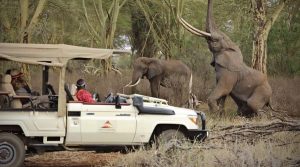
Because the park is so vast, sightings often feel completely wild. Lions are not accustomed to large numbers of vehicles and may be encountered resting beneath acacia trees, crossing dusty tracks, or stalking prey across the open plains with few other visitors nearby.
For many safari enthusiasts, that sense of wilderness is what makes Tsavo so special.
In the final section, we’ll explore where the original Tsavo lions are today, how to visit the places connected to their remarkable story, and answer the most frequently asked questions about these legendary predators.
Where Are the Tsavo Lions Now?
One of the questions visitors ask most often is, “Where are the original Tsavo lions today?”
Although the two infamous Man-Eaters were killed in 1898, their story did not end there.
Instead, they became some of the most carefully studied lions in history.
The Original Tsavo Lions at the Field Museum
After shooting the lions, Lieutenant Colonel John Henry Patterson kept their skins as trophies. For many years, the hides were used as rugs in his home before eventually being sold to Chicago’s Field Museum of Natural History in 1924.
Museum taxidermists restored the skins and mounted them into the lifelike displays that visitors see today.
The original skulls, bones, and preserved tissues have also been invaluable to scientists studying the famous predators.
Thanks to these specimens, researchers have been able to examine:
-
Their DNA
-
Tooth wear and injuries
-
Body size
-
Diet through isotope analysis
-
Age at death
-
Overall health
Few wild lions from the 19th century have been studied in such detail.
Their remains continue to provide new insights into lion behaviour and wildlife ecology more than a century after their deaths.
What Modern Science Has Revealed
For decades, people accepted Patterson’s account as the definitive version of events.
Today, modern science has helped answer many of the questions that remained unanswered for generations.
Researchers examining the lions discovered several important findings.
One Lion Had Serious Dental Problems
The most significant discovery involved one of the two lions.
Its lower canine tooth had broken long before the attacks.
The damaged tooth became badly infected, causing pain whenever the lion attempted to bite large prey.
This injury may have made hunting buffalo, zebra, and other powerful animals increasingly difficult.
Humans, by comparison, were slower, less dangerous, and easier to overpower.
While the dental injury alone does not explain every attack, it almost certainly influenced the lion’s hunting choices.
The Two Lions Didn’t Eat the Same Amount of Human Flesh
Chemical analysis of hair and bone samples revealed another surprising fact.
One lion consumed considerably more human flesh than the other.
This suggests the pair did not contribute equally to the attacks.
One may have become the primary hunter of humans, while the other participated less frequently or relied more heavily on natural prey.
This finding challenged the long-held assumption that both lions behaved identically.
They Were Healthy Wild Lions
Apart from the damaged tooth, both lions appeared physically healthy.
They were not abnormally large monsters, nor were they diseased animals driven mad by illness.
Instead, they were experienced adult predators living during a period of unusual environmental pressures.
This conclusion has helped shift the discussion away from myths and toward a better scientific understanding of predator behaviour.
Can You Still See Lions in Tsavo?
Absolutely.
Tsavo remains one of the best places in Kenya to see wild lions.
Unlike smaller reserves where lions are frequently surrounded by safari vehicles, Tsavo offers a far more natural experience.
The park’s immense size allows predators to roam freely across enormous territories.
Some visitors encounter lions resting beneath acacia trees.
Others watch prides crossing open plains at sunrise.
Lucky travellers may witness hunts, territorial disputes, or playful cubs interacting with their mothers.
Because there are fewer vehicles than in many popular safari destinations, every sighting feels genuinely wild.
Best Places to See Lions in Tsavo
Both parks offer excellent opportunities.
Tsavo East National Park
Tsavo East is known for its vast open plains, scattered baobab trees, seasonal rivers, and famous red elephants.
The open landscape makes wildlife easier to spot, particularly during the dry season when animals gather around permanent water sources.
Lions are often seen near:
-
Aruba Dam
-
Voi River
-
Galana River
-
Lugard Falls
-
Mudanda Rock
Morning and late afternoon game drives provide the highest chances of sightings.
Tsavo West National Park
Tsavo West offers a completely different experience.
Here the landscape includes volcanic hills, lava flows, rocky outcrops, dense woodland, and natural springs.
Although vegetation is thicker, patient visitors are regularly rewarded with memorable lion sightings.
Other highlights include:
-
Mzima Springs
-
Shetani Lava Flow
-
Chyulu Hills viewpoints
-
Ngulia Rhino Sanctuary
Many photographers appreciate Tsavo West because its dramatic scenery creates spectacular wildlife images.
When Is the Best Time to See Tsavo Lions?
Lions can be seen throughout the year, but some seasons offer better viewing conditions.
June to October
This is generally considered the best safari season.
Dry conditions reduce vegetation, making wildlife easier to find.
Animals concentrate around rivers, dams, and waterholes, increasing the chances of predator sightings.
January to March
Another excellent period.
The weather is warm and relatively dry, while many animals remain close to permanent water.
Birdlife is also exceptional during this time.
April and May
These months usually bring the long rains.
The landscape becomes beautifully green, but thick vegetation can make wildlife more difficult to locate.
However, fewer visitors often mean a quieter safari experience.
Planning a Tsavo Safari
Whether you’re interested in wildlife photography, family adventures, or simply seeing the landscapes made famous by the Man-Eaters, Tsavo offers something for every traveller.
Popular safari options include:
-
2-Day Tsavo Safari – Ideal from Mombasa, Diani, Watamu, Kilifi, or Malindi.
-
3-Day Tsavo East & West Safari – Explore both parks and experience their contrasting landscapes.
-
Tsavo by SGR Train – Travel comfortably from Nairobi or Mombasa before joining a guided safari.
-
Fly-in Tsavo Safari – Perfect for travellers with limited time who want to maximise game viewing.
A knowledgeable guide can also point out historic locations associated with the Uganda Railway and explain how the famous events of 1898 unfolded within today’s national park.
Frequently Asked Questions About the Tsavo Lions
Are Tsavo lions extinct?
No. The two famous Man-Eaters died in 1898, but Tsavo continues to support a healthy population of wild lions.
Why are Tsavo lions maneless?
Many male Tsavo lions have shorter manes because of the region’s hot climate, dense thorn bush, and long-term environmental adaptation. Not every male is completely maneless.
How many people did the Tsavo lions kill?
The exact number remains uncertain. John Henry Patterson claimed 135 victims, while modern scientific research suggests the lions probably consumed the equivalent of around 35 people. Most historians agree the true figure lies somewhere between the official railway records and Patterson’s estimate.
Who killed the Tsavo lions?
Lieutenant Colonel John Henry Patterson shot both lions in December 1898 after weeks of tracking and night watches.
Where are the original Tsavo lions now?
The mounted lions, along with their skulls and other remains, are preserved at the Field Museum of Natural History in Chicago, where they continue to be studied by scientists.
Do Tsavo lions still attack people?
Attacks are extremely rare today. Modern wildlife management, protected national parks, and improved safety measures mean visitors can enjoy safaris with experienced guides in a safe environment.
Which is better, Tsavo East or Tsavo West?
Both parks offer outstanding wildlife experiences.
Tsavo East is known for its wide-open plains and easier game viewing, while Tsavo West features volcanic scenery, natural springs, and more varied landscapes. Many visitors choose to explore both parks on the same safari.
How far is Tsavo from Nairobi?
The journey by road takes approximately 5 to 6 hours depending on your destination within the park. Travellers can also use the Standard Gauge Railway (SGR) or take scheduled flights to nearby airstrips.
Experience the Land of the Legendary Tsavo Lions
The story of the Tsavo lions is one of Africa’s most remarkable wildlife legends. It combines history, science, engineering, and conservation into a tale that continues to capture imaginations around the world.
Yet the greatest chapter is not the one preserved in museums or history books.
It is the one still unfolding across the vast plains of Tsavo National Park, where lions continue to patrol ancient territories, raise cubs, and reign as one of Kenya’s most iconic predators.
For travellers, there is no substitute for seeing these magnificent animals in the wild. Whether you’re watching a pride resting beneath a baobab tree, hearing a lion’s roar echo across the savannah at dawn, or following fresh tracks with an experienced guide, a safari in Tsavo offers an unforgettable connection to one of Africa’s greatest conservation landscapes.
At TheHolidayDealers, we specialise in tailor-made Tsavo safaris from Nairobi, Mombasa, Diani, Watamu, Kilifi, and Malindi. Whether you prefer travelling by road, the SGR train, or a fly-in safari, our local travel experts can help you choose the perfect itinerary to experience the home of Kenya’s legendary Tsavo lions.